

The answer to the question of whether it is more challenging to become an MRI technologist than a nurse is not a straightforward one.
The two professions are inextricably linked in healthcare, each with its own unique challenges and rewards. Efforts required in one direction or the other are dependent on personal strengths, interests, and career ambitions.
Educational Pathways: MRI Technologist vs. Nurse
MRI Technologist Education
To become an MRI technologist, one will need:
- Associate Degree: 2 years of radiologic or other related technology.
- Certification: Although it is not a requirement in every state, certification is a desired feature among employers.
- Clinical Training: Hands-on training to use MRI equipment and learn about imaging protocols.
The U.S. Bureau of Labor Statistics indicates that MRI technologists typically require an associate’s degree, although some may also require certification, depending on state laws and regulations.
Nurse Education
The nurses can choose between several educational directions:
- Associate Degree in Nursing (ADN): A 2-year course.
- Bachelor of Science in Nursing (BSN): A 4-year course.
- Licensure: To become a registered nurse, one needs to pass the NCLEX-RN exam.
Clinical training is also provided to nurses during their education, enabling them to acquire the skills necessary to provide patient care.
Skill Sets and Daily Responsibilities
MRI Technologist Skills and Duties
MRI technologists focus on operating advanced imaging equipment to create detailed internal images of the human body. Their core responsibilities include:
- Patient Preparation: Explaining procedures and ensuring patients are comfortable.
- Technical Expertise: Adjusting MRI machine settings and positioning patients for accurate imaging.
- Safety Protocols: Following strict radiation and magnetic safety guidelines.
- Image Analysis: Reviewing images for clarity before submission to radiologists.
In 2025, MRI technologists in the U.S. handle an average of 15–20 scans per day, requiring them to pay close attention to detail and precision. Strong technical aptitude and problem-solving skills are critical.
Nurse Skills and Duties
Nurses engage in direct patient care, requiring a mix of clinical knowledge and interpersonal skills. Key responsibilities include:
- Patient Monitoring: Recording vital signs and observing changes in patient conditions.
- Medication Administration: Delivering prescriptions safely and monitoring effects.
- Patient Support: Educating patients and providing emotional support.
- Collaboration: Working with doctors and other healthcare staff to coordinate care.
On average, a registered nurse in 2025 may care for 4–6 patients per shift in a hospital setting, often managing multiple emergencies simultaneously. Strong communication and multitasking are essential.
Career Outlook and Job Market Trends
MRI Technologist Career Outlook
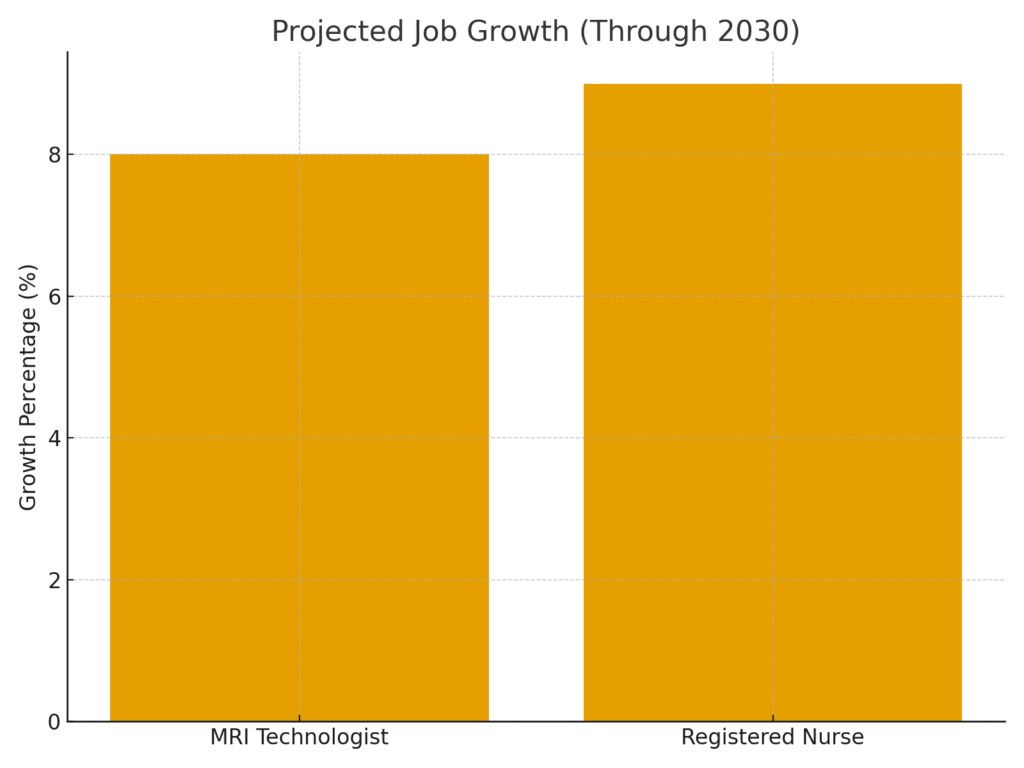
The demand for MRI technologists is projected to grow by 8% through 2030, driven by the increasing use of imaging in diagnostic procedures. Key statistics:
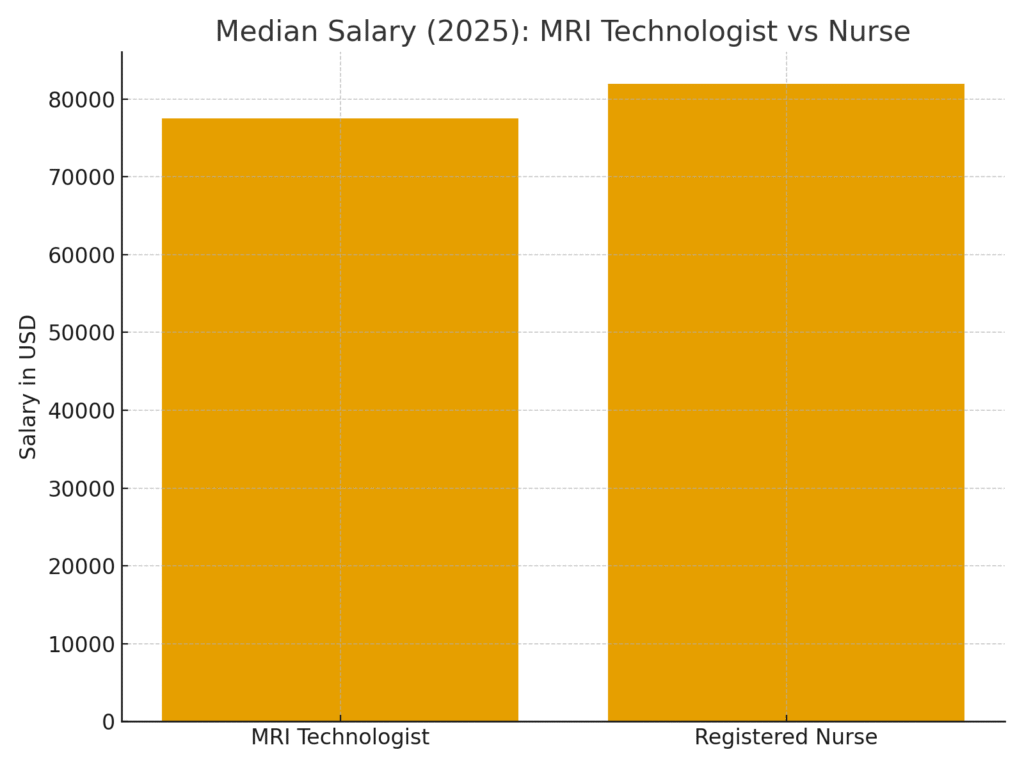
- Median Salary (2025): $77,500 per year in the U.S.
- Top-paying states include California, New York, and Texas, with salaries reaching up to $95,000 per year.
- Job Stability: Hospitals, outpatient centers, and specialized clinics constantly need skilled technologists.
Nursing Career Outlook
Nursing remains a high-demand profession, with employment projected to grow by 9% by 2030. Key statistics:
- Median Salary (2025): $82,000 per year for registered nurses.
- Top-Paying States: California, Massachusetts, and Hawaii, with annual earnings reaching up to $110,000.
- Job Security: Hospitals, home care, and telehealth services create diverse opportunities.
Work Environment and Patient Interaction
MRI Technologist Work Environment
MRI technologists typically work in hospitals, outpatient imaging centers, and diagnostic clinics. Their environment is:
- Controlled: Limited exposure to patients for short durations per scan.
- Specialized: Focused on operating complex imaging machinery.
- Shift Patterns: Standard day shifts, though some facilities require evenings or weekends.
Patient interaction is generally brief but essential, involving the explanation of procedures and ensuring patient comfort during scans. Technologists require patience and strong communication skills, but the emotional demands are generally lower than those of nurses.
Nurse Work Environment
Nurses work in a broader range of healthcare settings, including hospitals, clinics, nursing homes, and home care. Their environment is:
- Dynamic: Managing multiple patients with varying conditions simultaneously.
- High-Stress: Emergencies and critical care require rapid decision-making and response times.
- Shift Patterns: Rotating shifts, nights, weekends, and holidays are common.
Patient interaction is constant and intensive, requiring emotional resilience and excellent interpersonal skills to provide both medical and emotional support.
Which Path Is Right for You?
Being an MRI technologist or a nurse is a matter of personal choice, and it will be based on your abilities, occupational interests, and career objectives:
MRI Technologist: This role is best suited for individuals who enjoy working in technical fields, focusing on accuracy, and imaging technology. It offers a decent wage, consistent demand, and regular working conditions with minimal emotional stress.
Nurse: This role is best suited for those who are empathetic, prefer working directly with patients, and can thrive in a high-pressure setting. Nursing offers better pay prospects, a variety of possibilities, and a very fulfilling job with constant personal engagement.
Both jobs offer promising growth opportunities, along with competitive salaries in 2025, making them attractive options in the healthcare sector. Finally, the more difficult route is more a matter of subjective choice and relies on the ability to excel in technical accuracy or the practicality of working with patients.
FAQs
How difficult is it to become an MRI technician?
Becoming an MRI technician requires completing an associate degree, obtaining certification, and gaining clinical experience. It’s moderately challenging, mainly due to the technical skills and attention to detail required.
Which is best, radiology or nursing?
The choice depends on your interests: radiology suits those who prefer technical imaging work, while nursing is ideal for hands-on patient care and direct interaction with patients.
How stressful is being an MRI technologist?
Stress is moderate, primarily due to the need for precise imaging and patient safety, but it’s generally less emotionally demanding than nursing.
What is the hardest part of being a radiographer?
The most challenging part is striking a balance between technical accuracy and patient comfort, managing complex equipment, and handling unexpected clinical situations.