

Being an MRI Technologist may be the right course of action, providing you with a fulfilling healthcare experience that allows you not only to work with cutting-edge technology but also to engage with patients.
The need for professional MRI technicians in California is still growing as a result of the high population of this state, the development of health care facilities, and the trend of more and more people willing to obtain diagnostic tests.
The US Bureau of Labor Statistics predicts an even higher rate of MRI technologist employment, 7% increase by those years (2022-2032), which is higher than the growth rates of numerous other jobs.
California is one of the most favorable states to choose this profession. It not only guarantees good salaries that range between $95,000 and $110,000 per year, but also offers opportunities in some of the leading medical institutions in the country, including Los Angeles, San Diego, San Francisco, and Sacramento.
Having proper education, certification, and a state license, you will be able to secure a stable job, which, in turn, makes a significant difference in the lives of people.
Whether you’re just graduating from high school, switching careers, or already working in the medical field, this guide will walk you step by step through the process of becoming an MRI technologist in California and what you need to succeed.
Step 1: Understand MRI Tech Requirements in California
Before enrolling in any program, it’s crucial to know the specific requirements for becoming an MRI technologist in California. Unlike some states, California has stricter regulations to ensure patient safety and professional competency. Here are the main prerequisites:
- Educational Background – You’ll need at least a high school diploma or GED, ideally with strong foundations in biology, physics, and mathematics. Many MRI tech programs in California prefer applicants who have completed college-level courses in anatomy and physiology.
- Formal Training – California requires MRI techs to complete an accredited radiologic technology or MRI technology program. This ensures you receive both classroom instruction and hands-on clinical training.
- Certification – To practice legally, you must earn accreditation from the American Registry of Radiologic Technologists (ARRT) in MRI or radiography. This is a nationwide requirement, but is especially enforced in California.
- State License – In addition to ARRT certification, you must apply for a license through the California Department of Public Health – Radiologic Health Branch (RHB). This verifies your qualifications and allows you to work within the state.
- Soft Skills – Beyond technical knowledge, MRI techs in California are expected to have excellent communication, problem-solving, and patient care skills, since they work closely with patients during sometimes stressful procedures.
The first significant step in mapping your path to becoming an MRI tech in California is to understand these requirements. All these requirements will ensure you progress to the next step, which is selecting the right educational program.
Step 2: Enroll in Accredited MRI Tech Programs in California
The next step would be to obtain formal education by enrolling in an approved MRI tech program in California once one meets the basic requirements. It is essential to choose the right program, as it sets the foundation for your career and ensures that you will be eligible for certification and licensure.
Why Accreditation Matters:
Only programs accredited by the Joint Review Committee on Education in Radiologic Technology (JRCERT) or approved by the California Department of Public Health meet the state’s standards. Accreditation guarantees that the curriculum covers essential topics such as anatomy, patient care, imaging physics, safety, and MRI-specific protocols.
Program Options in California:
- Community Colleges – Affordable options that often provide Associate of Science (AS) degrees in Radiologic Technology or MRI Technology. Examples include programs offered in Los Angeles, San Diego, and the Bay Area.
- Universities – Some California universities offer bachelor’s degrees in medical imaging, which can provide greater career advancement opportunities.
- Private and Vocational Schools – These institutions often offer accelerated programs, allowing you to complete your training in 18 to 24 months.
Admission Requirements:
Most programs require a minimum GPA of 2.5, prerequisite coursework in math and sciences, background checks, immunization records, and sometimes healthcare-related volunteer or work experience.
Program Duration and Cost:
- Associate programs: 2 years
- Bachelor’s programs: 4 years
- Tuition ranges between $6,000 and $25,000 per year, depending on whether you attend a public or private school.
By completing one of these MRI tech programs in California, you’ll be well-prepared to transition into hands-on training and eventually take your certification exams.
Step 3: Clinical Training and Certification Process
Classroom learning is only half the journey; the other half is hands-on experience through clinical training. This phase allows you to apply theoretical knowledge directly in a hospital or imaging center setting, under the supervision of licensed professionals.
Clinical Training:
- Programs typically require 1,000–1,500 clinical hours.
- During this time, you’ll practice patient positioning, safety procedures, contrast administration, and operating MRI machines.
- Training sites often include large hospitals, outpatient diagnostic centers, or specialty clinics across California.
Certification Requirements:
After completing your education and clinical training, the next step is to obtain certification from the American Registry of Radiologic Technologists (ARRT) in Magnetic Resonance Imaging. To qualify, you must:
- Graduated from an accredited MRI or radiologic technology program.
- Complete required clinical competencies.
- Pass the ARRT MRI certification exam, which includes about 200 questions covering imaging procedures, patient care, and safety.
Why Certification is Important in California:
California employers strongly prefer or require ARRT-certified MRI technologists because it demonstrates professional competency. Without certification, your chances of securing employment are minimal.
Additional State Requirements:
Beyond ARRT certification, you’ll need to apply for a license through the California Radiologic Health Branch (RHB). This state license, combined with ARRT credentials, fully authorizes you to practice as an MRI tech in California.
By completing clinical training and certification, you’ll have the technical expertise and legal credentials to start your career in one of California’s thriving healthcare systems.
Step 4: Licensing, Registration, and Continuing Education
After completing your education and passing the ARRT exam, the next critical step is to secure your California state license. This process ensures that only qualified and well-trained professionals are allowed to operate MRI machines in the state.
California State License Process:
- The California Department of Public Health – Radiologic Health Branch (RHB) oversees the licensing of MRI technologists.
- You’ll need to submit proof of ARRT certification, official transcripts from your program, and application fees.
- Once approved, you’ll be officially licensed to practice as an MRI tech in California.
Continuing Education Requirements:
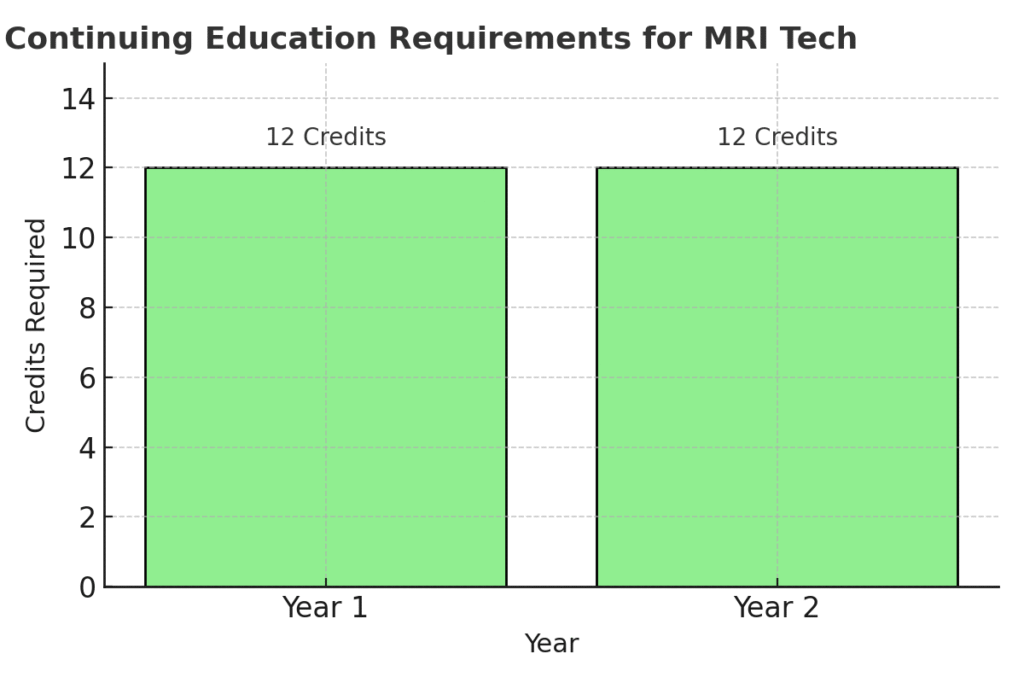
Licenses aren’t permanent. To maintain your MRI tech license in California, you must complete 24 continuing education credits every two years, as required by ARRT and the RHB. These courses can cover new imaging technologies, patient care improvements, or safety protocols.
Why Continuing Education Matters:
Medical imaging is a field that keeps changing. From cutting-edge MRI equipment to the latest safety measures, continuous learning makes you competitive in the job market and, at the same time, offers the best treatment to patients.
In brief, not only is it necessary to have a state license and to devote oneself to continuing education to meet the law, but it will also make one more professionally stable in the healthcare sector in California.
Step 5: MRI Tech Salary and Job Outlook in California
One of the biggest attractions of becoming an MRI technologist in California is the high salary and strong job security. With a growing demand for diagnostic imaging, MRI techs are in a great position to build long-term, financially rewarding careers.
Average Salary in California:
- The average annual salary for MRI technologists in California ranges from $95,000 to $110,000, which is significantly higher than the national average of approximately $82,000.
- Entry-level MRI techs typically start around $75,000 to $85,000 per year, while experienced professionals in large hospitals or specialized clinics can earn over $120,000 annually.
Top-Paying Cities in California (2025 estimates):
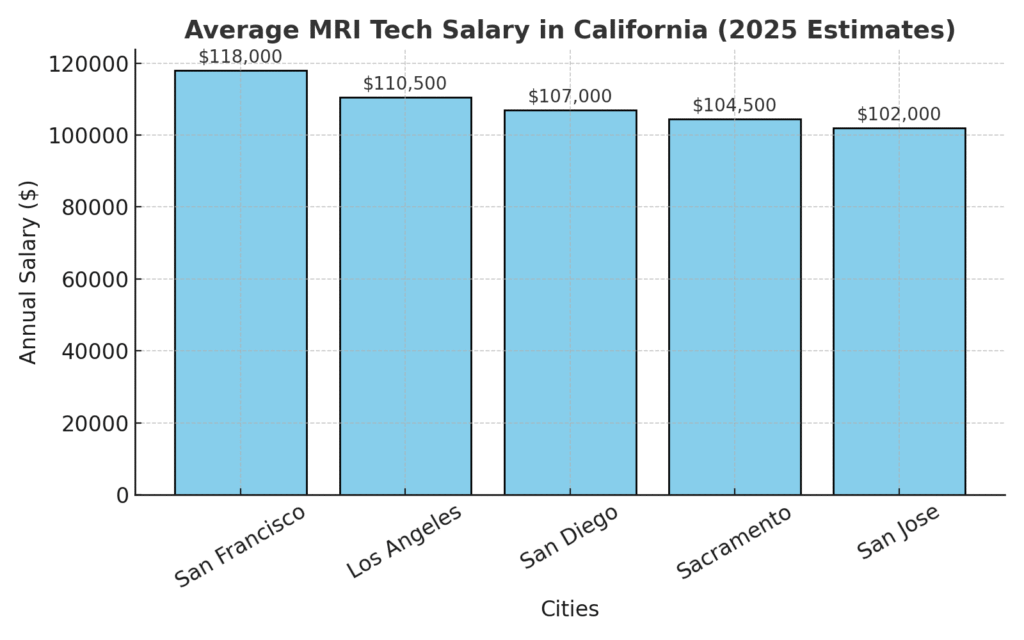
- San Francisco – Average $118,000
- Los Angeles – Average $110,500
- San Diego – Average $107,000
- Sacramento – Average $104,500
- San Jose – Average $102,000
Job Outlook:
- The US Bureau of Labor Statistics projects a 7% job growth for MRI technologists nationwide between 2022 and 2032.
- In California, the growth rate is even stronger due to the state’s expanding hospital networks, aging population, and high-tech healthcare facilities.
- Job opportunities are especially abundant in metropolitan areas, but smaller cities and rural regions also show steady demand.
Additional Benefits:
- Many employers in California offer health insurance, retirement plans, and tuition reimbursement for continuing education.
- With career advancement, MRI techs can move into roles such as lead technologist, clinical supervisor, or MRI applications specialist, further boosting salary potential.
In summary, becoming an MRI tech in California not only provides a stable and growing career path but also comes with one of the most competitive salary ranges in the medical imaging field.
Conclusion
The process of becoming an MRI technologist is challenging in California as it involves education, training, and licensing to a satisfying profession.
Since it takes meeting the basic qualifications and registration in an accredited program to the final moment of clinical training, ARRT certification, and your California state license, every step is a step that builds you to become the next player in this very sought-after healthcare industry.
It is worthwhile in terms of time and energy. With average salaries of between $95,000 and $110,000 a year, MRI techs in California are very well paid, and their job terms are quite secure with a good career growth perspective.
You can be in the top hospitals in Los Angeles or San Francisco, but you can also work in the community healthcare center anywhere in the state. This profession can provide professional fulfillment and financial security.
Most importantly, MRI technologists play a critical role in patient care, assisting physicians in identifying and managing medical conditions through accurate diagnostic imaging.
Whether you are enthusiastic about technology, love working with patients, and wish to join the active healthcare system in California, it is high time to start your career.
With dedication and the proper guidance, you can turn your ambition into a thriving career and proudly call yourself a licensed MRI tech in California.
FAQs
How long does it take to become an MRI technician in California?
It usually takes 2 to 4 years, depending on whether you pursue an associate or bachelor’s degree, plus clinical training and licensing.
How much does an MRI tech make in California?
MRI technologists in California earn an average of $95,000 to $110,000 annually, with top cities paying over $120,000.
What is the fastest way to become an MRI tech?
The quickest route is completing an 18–24 month accredited associate program and passing the ARRT exam for certification.
How to become an MRI tech in the US?
Complete an accredited MRI or radiologic technology program, gain clinical experience, pass the ARRT certification exam, and apply for your state license.