

Medical imaging is a rapidly growing sphere, and MRI (Magnetic Resonance Imaging) technicians are in demand in the market more than ever. Conventionally, one has needed an associate’s/bachelor’s degree in radiologic technology or in a healthcare profession to become a radiologic technologist.
However, in 2025, when alternative learning options, certifications, and in-the-job training become more popular, a more rhetorical question arises among many: Can you become an MRI tech without a degree?
Yes, it is, but then it must be the right mix of certifications, practical experience, and a desire to keep learning. This guide will also take you through the process of becoming an MRI technologist without a traditional degree, the certifications you should hold, and the career opportunities that will be available to you in 2025.
Understanding the Role of an MRI Technician in 2025
It is important to get the idea of what an MRI tech does before immersing themselves in the pathways. MRI technicians use magnetic resonance imaging (MRI) equipment to produce detailed internal body images of a patient’s organs, tissues, and systems. Such pictures play a major role in the diagnosis of medical conditions such as neurological disorders and joint injuries.
The role is now enhanced in terms of sophisticated imaging technology, the integration of artificial intelligence, and patient-centred models of care in 2025.
Being an MRI tech does not mean that an individual is only to press buttons, but to ensure the safety of patients, to place people in the right places, to communicate effectively, and to cooperate with radiologists and physicians to ensure the right results are obtained.
Key responsibilities of an MRI technician include:
- Preparing and positioning patients for scans.
- Operating MRI machines and adjusting settings for high-quality images.
- Ensuring patient safety, especially for those with implants or medical devices.
- Maintaining detailed patient records and scan reports.
- Staying updated with the latest imaging protocols and safety standards.
By understanding the scope of the job, aspiring MRI techs — even without a degree — can see why training, certification, and skill development are essential to entering this career.
Do You Really Need a Degree to Become an MRI Tech?
Historically, the most prevalent route to becoming an MRI technologist has been by receiving an associate or bachelor’s degree in radiologic technology or any other medical imaging speciality. Most employers in the past favoured degree holders due to their ability to show formal education and knowledge.
Nonetheless, the healthcare industry is becoming flexible in 2025. As the number of people seeking skilled professionals in imaging continues to increase, several hospitals, diagnostic centres, and individual clinics are opening their doors to those who lack a degree but possess the relevant certifications and on-the-job training.
It is not necessarily the degree, but the capabilities, certifications, and clinical experience that you bring that matter most today. Employers desire technicians who are capable of using the MRI equipment with confidence, adopting safety measures and ensuring proper imaging outcomes.
Even without ever having to enrol in the usual four-year college program, you can still succeed in making a career as an MRI tech because they can verify your competency via certification and practice.
Alternative Routes to Becoming an MRI Tech Without a Degree
If you’re serious about entering this field but don’t have a degree, the good news is that several alternative routes are available in 2025. These options allow you to bypass long academic programs while still gaining the technical skills and credentials employers require.
Here are the most common alternatives:
- Certificate Programs in MRI Technology – Many accredited institutions offer certificate-based MRI training that can be completed in 12–18 months. These focus heavily on practical training rather than lengthy academic coursework.
- On-the-Job Training – Some hospitals and imaging centres hire entry-level medical assistants or radiology aides and provide on-the-job MRI training. This path allows you to learn directly under licensed technologists while earning a paycheck.
- ARRT Pathway Without a Degree – The American Registry of Radiologic Technologists (ARRT) allows non-degree candidates with approved clinical training to sit for their certification exam, provided they meet eligibility criteria.
- Online MRI Tech Training – Online courses have become more popular in 2025, offering flexible schedules and virtual simulations of MRI procedures. Pairing an online course with a clinical internship can make you job-ready without formal college enrollment.
- Military or Vocational Training – In some regions, military medical training programs and vocational schools offer accelerated MRI pathways where degree requirements are waived if you complete specialised training modules.
Each of these routes requires dedication, but they prove that you can indeed enter this high-demand field without committing to years of expensive college education.
Certifications That Can Replace a Degree in 2025
The most crucial aspect, as far as becoming an MRI tech without a degree, is certifications. Indeed, the level of certifications is the golden ticket in 2025 that will confirm your expertise and skills in the sphere. Certifications are the next criterion that employers are likely to consider as evidence that you can work well in the job, despite not having a college diploma.
Here are the key certifications that can replace a degree in 2025:
- ARRT Certification (American Registry of Radiologic Technologists) – The ARRT is the most recognised certification in medical imaging. You can qualify for the ARRT exam through structured educational programs or alternative pathways. Once certified, you become far more employable, even without a degree.
- State Licensure – Some U.S. states permit MRI technologists to practice with state-issued licenses after completing a certification course and passing the required exams. Requirements vary by state, but many do not mandate a degree.
- CPR and Patient Safety Training – Basic certifications in patient safety and CPR are often required, and they strengthen your employability.
- Continuing Education Credits – Staying current with annual or biannual continuing education requirements ensures that your knowledge remains updated with the latest MRI technology in 2025.
In many cases, employers will hire candidates with ARRT or equivalent certification over those with just a degree but no hands-on experience. This makes certification not just an alternative, but a powerful way to enter the field faster.
Skills and Experience That Can Boost Your Career Without a Degree
Even with certifications, you’ll need the right combination of skills and practical experience to succeed as an MRI tech without a degree. Employers value technicians who can handle both the technical and human aspects of the job.
Technical Skills:
- Operating MRI machines with accuracy.
- Understanding imaging protocols for different body parts.
- Knowledge of radiation safety and patient positioning.
- Troubleshooting imaging software and equipment issues.
Soft Skills:
- Strong communication and empathy to guide patients through sometimes stressful procedures.
- Attention to detail for accurate imaging and reporting.
- Teamwork skills to collaborate with radiologists, nurses, and doctors.
- Critical thinking for problem-solving in fast-paced medical environments.
Hands-On Experience:
The best way to build these skills without a degree is through internships, volunteer opportunities, or hospital-based training programs. Even entry-level roles like radiology assistant or imaging aide can give you exposure to MRI machines and patient care.
In 2025, employers are more flexible about formal education but remain strict about one thing: proven competency. If you can demonstrate real-world skills and strong patient interaction, you can thrive in this career without needing a degree.
Job Opportunities and Salary Expectations for MRI Techs Without a Degree
One of the biggest concerns for anyone considering this career path is job security and earning potential. The good news is that the demand for MRI technicians continues to grow in 2025. According to U.S. labour data, the employment of MRI technologists is projected to grow by 7–9% over the next decade, which is faster than the average growth rate for healthcare professions.
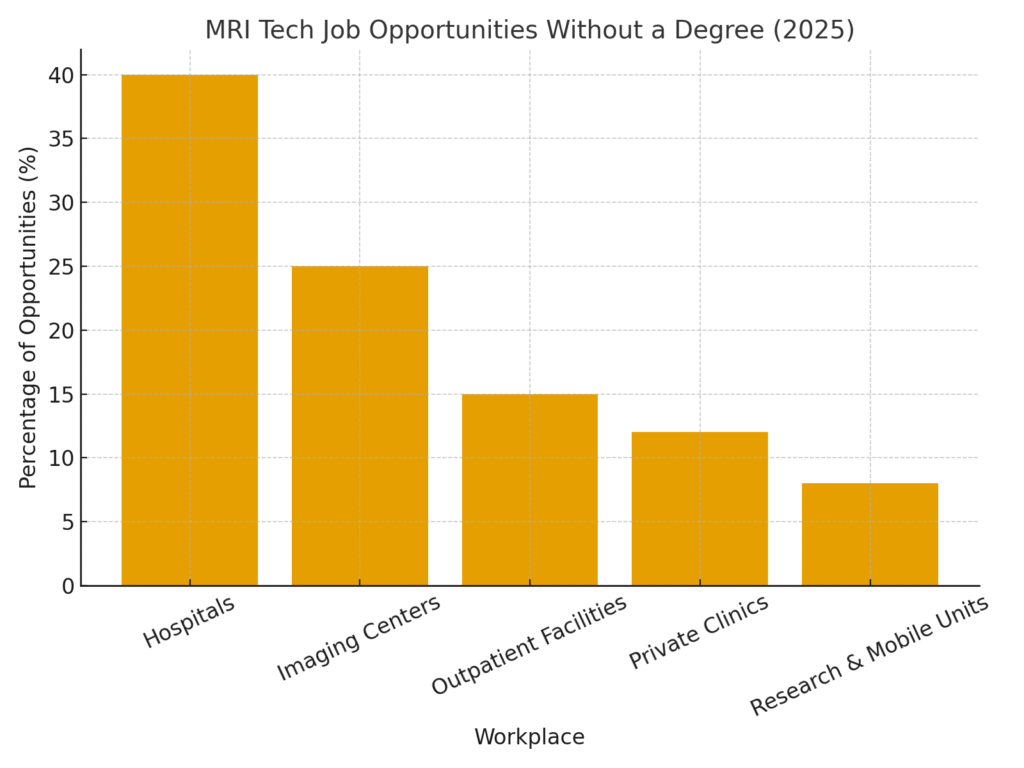
Even without a degree, certified MRI techs can secure stable positions in:
- Hospitals and diagnostic imaging centres
- Outpatient care facilities
- Private radiology clinics
- Research institutions
- Mobile imaging units
Salary Expectations in 2025
An MRI technologist earns an average annual salary of between $65,000 and $85,000 in the U.S., depending on location, certification, and experience. MRI techs who have not graduated with a degree can begin at the bottom, earning an average of $55,000/year, although with further credentials and experience, they can jump up the pay ladder in a short period.
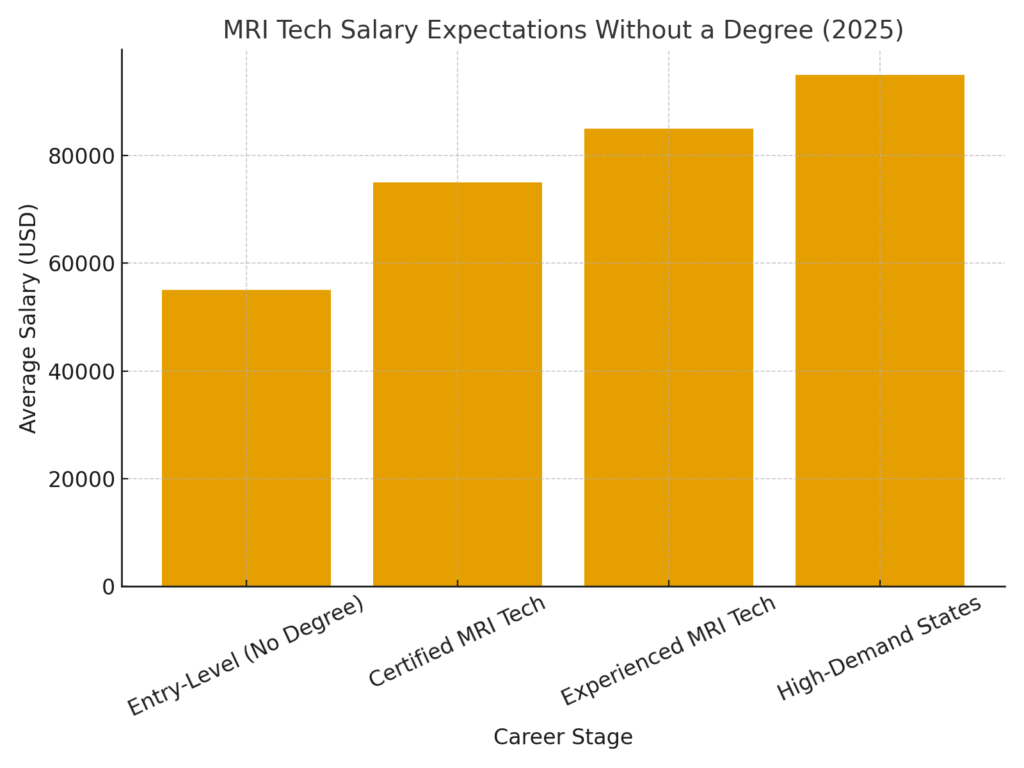
MRI techs are making more than $90,000 per year in certain states with high demand. Employees holding night shifts or working in work-specialised hospitals could also be eligible for additional pay bonuses. This profession is as financially attractive and secure as it is profitable, despite those candidates who prefer the non-degree route.
Is Becoming an MRI Tech Without a Degree Worth It?
By 2025, the healthcare sector will be more appreciative of skills, certifications, and work experience as much as a conventional degree. To the would-be MRI techs, this translates to the fact that your gateway to a good and well-remunerating profession is open even without college.
There is discipline involved in this course of action. You will have to spend money on certifications, practical training, and constantly upgrade your knowledge as the MRI technology changes.
However, the prize is a profession where you will have an opportunity to really make a difference in the lives of patients, as well as good employment security and a good salary.
Thus, is the point of earning an MRI tech degree worth it? Yes, of course, as long as you are motivated, you want to learn, and are willing to find other ways to reach the top. Following the right steps, you will be able to make your interest in healthcare a well-paying, purposeful and long-term career.
FAQs
What is the fastest way to become an MRI tech?
The fastest way is completing a 12–18 month MRI certificate program combined with clinical training. This path skips a full degree but still prepares you for certification exams.
What qualifications do you need to run an MRI?
You need professional certification, such as ARRT, and in some states, a license to operate MRI machines. Hands-on training and patient safety knowledge are also essential.