

Diagnostic imaging, as a career in the healthcare sector, is highly sought in the present dynamic healthcare sector. Some of the best sellers include MRI Technologists as well as Ultrasound Technologists, who are very crucial in patient care and the detection of diseases.
The baby boomers are growing older, and since the elderly are more susceptible to health issues, new technology in imaging and more health issues, the number of skilled imaging professionals is going to be in high demand in 2025.
You may be asking yourself: What is more lucrative, MRI Tech or Ultrasound Tech in 2025? In case you are planning a career in medical imaging.
The question is answered based on such aspects as job responsibilities, education, earnings, and career aspirations. Through this article, you will have an in-depth comparison of MRI Tech vs Ultrasound Tech in 2025 and hence make a wise decision.
What Does an MRI Tech Do in 2025?
A Magnetic Resonance Imaging Technologist (MRI Technologist) is a specialist who is engaged in the process of recording the images of the human body in the most detail possible with the help of magnets and radio waves. This is because these images assist doctors in diagnosing complicated cases like brain tumors, spinal cord injuries, strokes, and joint diseases.
MRI technology has improved in 2025 through the use of faster imaging machines, AI-based software to increase its accuracy, and shorter scan times. This implies that MRI Techs should be in touch with the new systems when the safety and comfort of patients during scans are maintained.
Key responsibilities of an MRI Tech include:
- Preparing patients and explaining procedures clearly.
- Operating MRI machines to capture accurate images.
- Adjusting imaging settings for specific body parts.
- Monitoring patients for safety, especially those with implants or metal devices.
- Collaborating with radiologists to review and interpret scan results.
On average, MRI Techs often work in hospitals, outpatient centers, diagnostic labs, and specialized clinics. The job requires both technical expertise and strong interpersonal skills since patients may feel anxious during scans.
What Does an Ultrasound Tech Do in 2025?
The Ultrasound Technologist (also Diagnostic Medical Sonographer) uses sound waves to produce real-time images of internal organs, blood flow, and the unborn babies. Ultrasound is also one of the safest imaging modalities as compared to MRI, since it is not associated with radiation.
Ultrasound machines are more portable, and improved diagnostic images with AI-assisted diagnostics are achievable in 2025. This enables Ultrasound Techs to operate in a very diverse environment, both in hospitals and clinics, as well as in a mobile health care unit.
Key responsibilities of an Ultrasound Tech include:
- Performing abdominal, cardiac, vascular, obstetric, and musculoskeletal scans.
- Preparing patients and explaining procedures reassuringly and straightforwardly.
- Operating ultrasound equipment to capture accurate and clear images.
- Analyzing initial scan results and presenting them to radiologists or physicians.
- Assisting with interventional procedures such as biopsies or guided injections.
Ultrasound Techs interact closely with patients and often form strong connections, especially in fields like obstetrics, where they help parents see their baby for the first time. This makes the role both technically demanding and emotionally rewarding.
MRI Tech vs Ultrasound Tech: Education and Training Requirements
When comparing MRI Tech vs Ultrasound Tech in 2025, one of the most significant differences lies in education and training. Both fields require postsecondary education, but the length and specialization vary.
MRI Tech Education (2025):
- Most MRI Technologists begin with an Associate Degree in Radiologic Technology or a related field.
- Additional specialized MRI training or certification is required.
- Many states require certification from the American Registry of Radiologic Technologists (ARRT).
- Typical program length: 2 to 3 years.
Ultrasound Tech Education (2025):
- Ultrasound Techs often complete an Associate’s or Bachelor’s Degree in Diagnostic Medical Sonography.
- Some choose 1-year certificate programs if they already have a healthcare background.
- Certification is available through organizations like the ARDMS (American Registry for Diagnostic Medical Sonography).
- Typical program length: 2 to 4 years, depending on specialization.
In terms of difficulty, MRI Tech programs lean more toward physics and radiologic science, while Ultrasound Tech programs focus on anatomy, physiology, and patient care. Both require hands-on clinical training to develop technical skills and bedside manner.
Salary Comparison: MRI Tech vs Ultrasound Tech in 2025
Salary is often one of the most significant factors when deciding between MRI Tech and Ultrasound Tech careers. In 2025, both fields offer competitive pay, but MRI Techs generally earn slightly higher wages due to the complexity of the equipment and the specialized nature of the work.

MRI Tech Salary in 2025:
- Average annual salary: $86,000 – $95,000.
- Hourly rate: $38 – $45 per hour.
- Top-paying states: California, New York, Massachusetts, and Washington.
Ultrasound Tech Salary in 2025:
- Average annual salary: $82,000 – $90,000.
- Hourly rate: $36–$43 per hour.
- Top-paying states: California, Oregon, Colorado, and Hawaii.
While MRI Techs earn slightly more on average, Ultrasound Techs can close the gap depending on their specialization. For example, cardiac sonographers and vascular sonographers often command salaries on the higher end of the scale.
Both careers also offer opportunities for overtime, night-shift pay, and career advancement, which can significantly boost annual earnings.
Job Outlook and Career Growth in 2025
The career outlook for MRI Techs and Ultrasound Techs in 2025 remains strong due to rising healthcare demands, an aging population, and continuous advancements in imaging technologies.
According to projections, both fields are expected to see steady growth of 7%–10% from 2025 to 2030, faster than the average for all occupations.
MRI Tech Job Outlook 2025:
- Growth rate: Around 8%.
- Increased demand in neurology, orthopedics, and oncology, where MRI plays a key role in early detection.
- Expansion of outpatient diagnostic centers is driving hiring opportunities.
Ultrasound Tech Job Outlook 2025:
- Growth rate: Around 10%.
- Strong demand in obstetrics, cardiology, and vascular imaging.
- The portability of modern ultrasound equipment allows greater use in mobile clinics and telehealth services, broadening career opportunities.
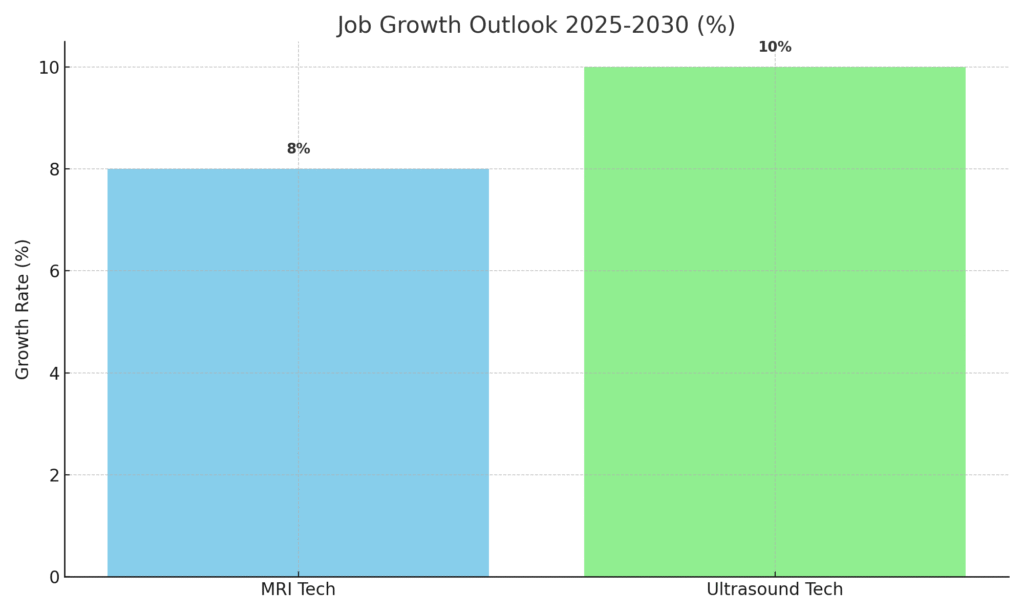
Overall, both professions have excellent job security and career growth. However, Ultrasound Tech roles may expand faster due to the versatility of ultrasound in different medical fields and its non-radiation-based safety advantage.
Work Environment and Lifestyle Differences
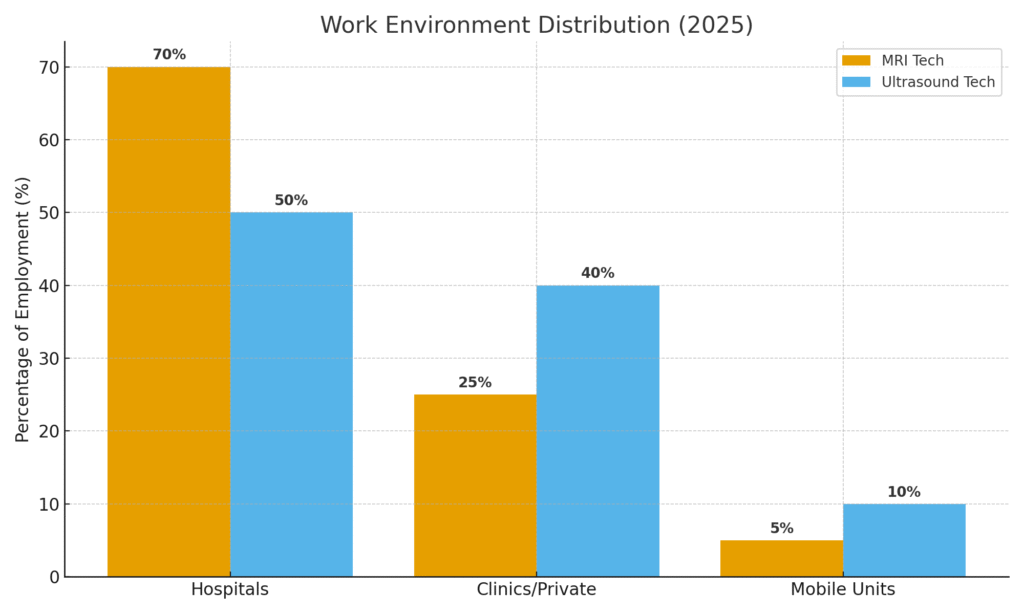
While both careers fall under diagnostic imaging, the work environment for MRI Techs and Ultrasound Techs in 2025 differs in essential ways.
MRI Tech Work Environment:
- Typical workplaces: hospitals, specialized imaging centers, and outpatient clinics.
- Work hours: Often include evening, overnight, and weekend shifts, especially in hospitals where 24/7 imaging services are required.
- Lifestyle: MRI Techs may deal with patients who are anxious about confined spaces (claustrophobia) or nervous about medical scans. This requires patience, clear communication, and reassurance.
Ultrasound Tech Work Environment:
- Typical workplaces: hospitals, OB/GYN offices, cardiology centers, and mobile clinics.
- Work hours: More likely to follow regular business hours, especially in private practices and OB/GYN offices. Emergency and hospital-based roles may still require night or weekend shifts.
- Lifestyle: Ultrasound Techs often form closer patient interactions, particularly in obstetrics, where they may conduct pregnancy scans. This adds an emotional and rewarding element to the career.
In short, MRI Techs may experience a more technical, fast-paced environment with variable schedules, while Ultrasound Techs often enjoy steadier hours and more patient-focused interactions.
Which Career Is Better in 2025: MRI Tech or Ultrasound Tech?
The question of whether MRI Tech or Ultrasound Tech is better in 2025 depends on personal goals, interests, and lifestyle preferences.
Why Choose MRI Tech?
- Higher average salary potential.
- Opportunity to work with cutting-edge imaging technology.
- Strong demand exists in specialties such as neurology, orthopedics, and oncology.
- Best for individuals who enjoy physics, technology, and problem-solving.
Why Choose Ultrasound Tech?
- Slightly faster job growth projections.
- Safer imaging method without radiation exposure.
- Emotional rewards in specialties like obstetrics and pediatrics.
- More flexible work schedules in private clinics and outpatient settings.
Ultimately, both professions are in demand and provide excellent job security. If you’re drawn to high-tech medical imaging and don’t mind shift work, MRI Tech may be the right path. If you prefer closer patient interaction with flexible hours, an Ultrasound Tech could be the better choice.
Choosing Between MRI Tech and Ultrasound Tech
Looking at the future of diagnostic imaging in the year 2025, both the MRI Technologists and Ultrasound Technologists are bright, consistent, and well-paying career choices.
Both fields have their own advantages: MRI Technologists have a better time with more sophisticated imaging systems and higher incomes, whereas Ultrasound Technologists have better working conditions since their work is less physically demanding and less risky. The employment rate is also more assured.
The choice will always be based on your interests, strengths, and lifestyle aspirations. MRI can become your calling if you are a technical, high-tech person who does not mind working irregular hours. Ultrasound may be the ideal setting for those who prioritize patient-centered care, emotional support, and flexible working hours.
Regardless of the career choice, both professions will be highly secure, offer career growth, and play an essential role in enhancing the health outcomes of patients in 2025 and beyond.
FAQs
What is the future of MRI technology?
MRI technology is expected to advance with faster imaging, AI-driven diagnostics, and improved patient comfort, making it a critical tool in healthcare through 2025 and beyond.
What is the future of ultrasound tech?
Ultrasound technology will continue to expand with the introduction of portable machines, AI-assisted imaging, and broader applications in mobile healthcare, telemedicine, and preventive diagnostics.
Which career is better, sonography or radiology?
Both careers are rewarding; sonography offers flexible hours and emotional rewards, while radiology (specifically, as an MRI Tech) provides higher salaries and opportunities for advanced technology.
What is the highest salary for an MRI tech?
In 2025, the highest salaries for MRI Technologists can exceed $110,000 annually, particularly in states such as California, New York, and Massachusetts.