

In the healthcare sector, diagnostic imaging is critical in diagnosing illnesses, developing the treatment plan and saving human lives. MRI and X-ray technologists are the most well-known imaging specialists.
Although the two professions are based on medical imaging, they are different in terms of training, equipment, career outlook, and remuneration. Such differences can be explained to enable students, career changers, and healthcare enthusiasts to make the right choice in relation to a career that suits them.
What Does an MRI Tech Do? Roles and Responsibilities
An MRI technologist or MRI tech, as he is commonly referred to, is a specialist in the work of an MRI machine that utilises the magnetic resonance imaging machines to produce images of the human body with a great level of detail. Powerful magnets and radio waves are used in these machines, and that is why patients are not subjected to radiation, as is the case with X-ray imaging.
MRI techs work closely with physicians to ensure accurate images are produced for diagnosing conditions such as brain tumours, spinal injuries, strokes, and joint disorders. Their responsibilities often include:
- Preparing patients for MRI scans and explaining the process clearly
- Positioning patients correctly to ensure clear and accurate imaging
- Operating MRI machines and monitoring the scanning process
- Recognising potential safety risks, especially with metal implants in patients
- Collaborating with doctors and radiologists to deliver high-quality diagnostic images
This career requires strong attention to detail and communication skills, as patients often feel nervous or claustrophobic during MRI scans. MRI techs play a critical role in reassuring patients while ensuring precise imaging results.
What Does an X-Ray Tech Do? Roles and Responsibilities
An X-Ray technologist, also known as a radiologic technologist or radiographer, uses X-Ray machines to capture images of the inside of the body. Unlike MRI scans that use magnets, X-rays rely on radiation to produce images of bones, chest cavities, and certain soft tissues.
The primary responsibilities of an X-Ray tech include:
- Preparing patients for X-ray examinations and positioning them correctly
- Operating X-Ray equipment safely to minimise radiation exposure.
- Taking images that help doctors diagnose fractures, lung conditions, arthritis, and digestive problems
- Maintaining patient records and ensuring imaging equipment is functioning properly
- Following strict safety guidelines to protect themselves and patients from unnecessary exposure
X-Ray technologists may be employed in hospitals, inpatient and outpatient clinics, and in imaging services. Since the X-rays are routinely requested in emergencies, the radiologic technologists should be fast, flexible, and accurate. This is also a demanding position, and one must have excellent communication skills to calm down patients in pain or distress.
MRI Tech vs X-Ray Tech: Education and Training Requirements
While both careers fall under the field of medical imaging, the education and training paths for MRI and X-ray techs differ slightly.
X-Ray Tech Education
- Most X-ray technologists begin with an associate degree in radiologic technology, which typically takes 2 years to complete.
- Coursework covers anatomy, patient care, radiation safety, and imaging procedures.
- Graduates must pass the certification exam from the American Registry of Radiologic Technologists (ARRT) to become licensed professionals.
MRI Tech Education
- Many MRI technologists start as radiologic technologists and then specialise in MRI through a post-certification program.
- Specialised MRI training usually takes 1 additional year and focuses on magnetic resonance imaging techniques, physics, and patient safety.
- Like X-ray techs, MRI technologists also need ARRT certification to practice.
Key Difference
The main distinction is that an X-ray tech can begin working in the field sooner with a standard radiologic technology degree, while an MRI tech usually requires additional training. This makes the path for MRI professionals slightly longer but also more specialised.
Salary Comparison: MRI Tech vs X-Ray Tech
Salary potential is one of the major considerations in a comparison of MRI tech and X-Ray tech careers. Even though the two professions offer good income, MRI technologists are best paid since they are highly specialised.
Average Salary of an X-Ray Tech
- According to the Bureau of Labour Statistics, the median annual wage for radiologic technologists in the United States is around 65,000 dollars.
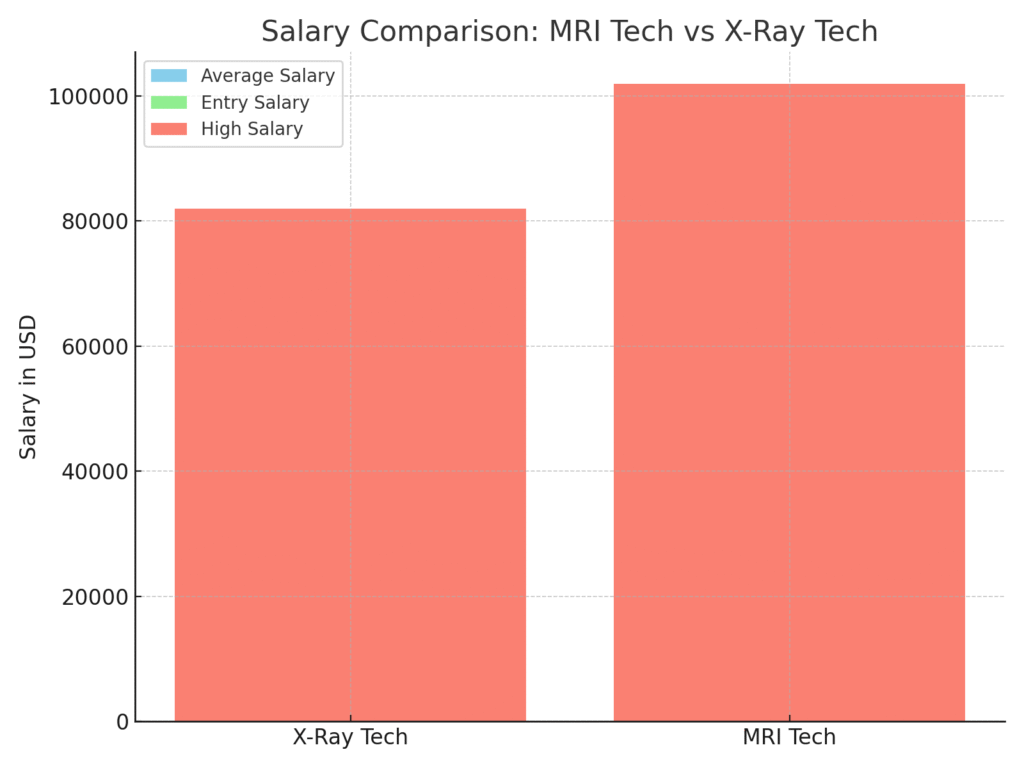
- Entry-level X-Ray techs often earn between 45,000 and 50,000 dollars, while experienced professionals in high-demand areas can make over 80,000 dollars annually.
Average Salary of an MRI Tech
- MRI technologists earn a higher median annual wage of about $80,000.
- Entry-level MRI techs may start around $55,000, but with experience and specialisation, salaries can climb above $100,000 per year.
Key Takeaway
MRI techs typically make 15,000 dollars more per year on average than X-Ray techs. This difference is largely due to the additional education required and the complexity of MRI procedures. For individuals motivated by higher earning potential, pursuing MRI technology may be more rewarding.
Job Outlook and Career Growth Opportunities
Both MRI technologists and X-Ray technologists benefit from strong job growth driven by an ageing population, increased use of diagnostic imaging, and advancements in medical technology.
Job Outlook for X-Ray Techs
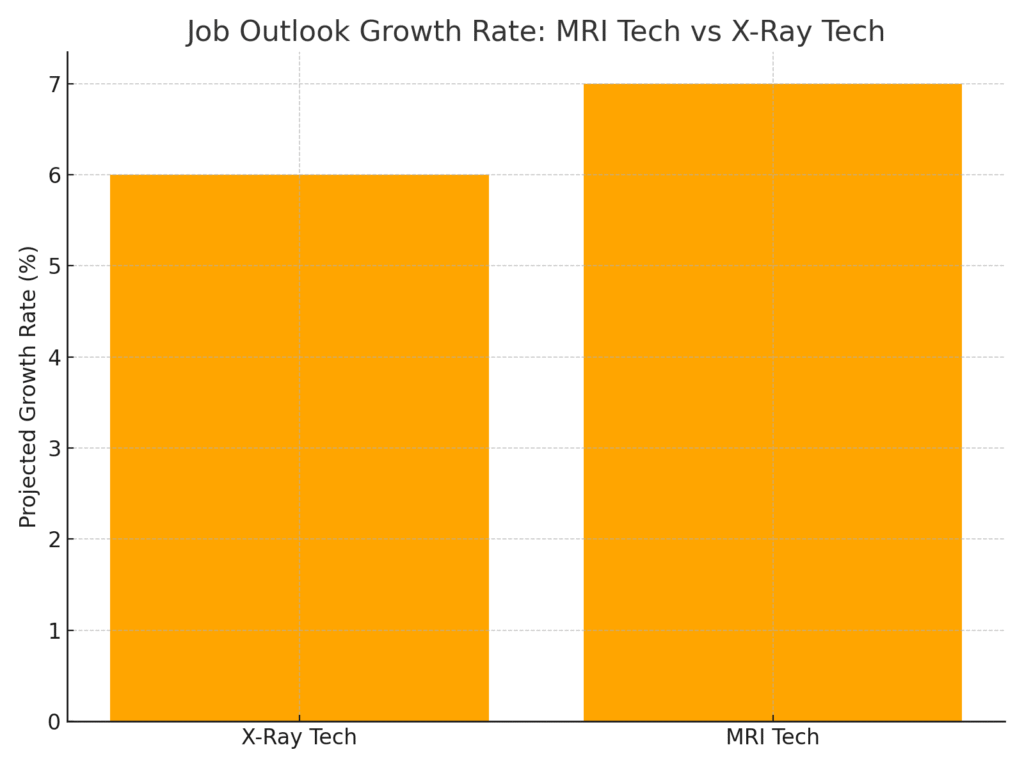
- Employment of radiologic technologists is projected to grow by about 6 per cent over the next decade, which is faster than the average for all occupations.
- Demand will continue to rise in hospitals, outpatient care centres, and urgent care clinics.
Job Outlook for MRI Techs
- MRI technologists have a projected growth rate of around 7 per cent in the coming years.
- As MRI becomes more widely available and preferred for non-invasive diagnostic purposes, demand for MRI specialists is expected to rise steadily.
Career Advancement Opportunities
Both fields offer opportunities to grow into supervisory roles, advanced imaging positions, or teaching. Some professionals move into healthcare administration or continue their education to become physician assistants or healthcare managers.
Overall, both careers promise stability, with MRI techs enjoying slightly stronger growth due to the rising use of advanced imaging technologies.
Which Career is Right for You? Key Factors to Consider
Deciding between becoming an MRI tech or an X-Ray tech depends on your interests, career goals, and personal strengths. Both paths are rewarding, but each offers unique challenges and benefits.
Consider X-Ray Technology if:
- You want to start working in the healthcare field sooner, since training typically takes two years.
- You enjoy working in fast-paced environments such as emergency rooms and urgent care centres.
- You are comfortable with radiation safety protocols and frequent patient interaction.
Consider MRI Technology if:
- You prefer working with advanced imaging equipment that provides highly detailed images.
- You are interested in specialising in areas like neurology, orthopaedics, or cardiology.
- You are willing to pursue additional training to gain higher salary potential and a more specialised role.
Both careers require strong interpersonal skills, as patients often feel nervous during procedures. Your ability to explain processes clearly, provide reassurance, and maintain patient comfort will be as important as your technical knowledge.
Conclusion
MRI and X-Ray technologists are both vital to the present-day healthcare system as they assist physicians in the diagnosis, detection, and treatment of a broad spectrum of medical-based disorders. As their roles overlap in patient care and imaging roles, technology, training, income, and work environment differ between them.
X-Ray technology represents the ideal option in case you want to enter the healthcare sector faster with good salaries and employment protection. Conversely, in case you want to have a speciality job with greater earning power and do not mind spending additional time in training, it would be more fulfilling to be an MRI technologist.
No matter what direction you take, both professions will provide you with the chance to leave a substantial mark on patient care already and establish a stable and gratifying future in healthcare.
FAQs
Is an MRI tech or a radiology tech better?
Neither is universally better since it depends on your goals. MRI techs earn more on average, while radiology techs enter the field faster with flexible career paths.
Which is better, X-ray or MRI?
X-ray is faster, cheaper, and ideal for fractures, while MRI offers more detailed images of soft tissues and complex conditions. The choice depends on the medical need.
What is the highest salary for an MRI tech?
Experienced MRI technologists in high-demand locations can earn over 100,000 dollars annually, especially with advanced certifications or specialisation.
What is the highest career in radiology?
The highest career in radiology is becoming a radiologist physician, who interprets imaging results and can earn salaries well above 300,000 dollars per year.